Back in school, there was often a thing where your friends would back you up when you had a ‘beef’ or grudge with another person. It didn’t matter whether they were part of that disagreement or not; as long as word got out that you were now on that no-friend list, they would all blacklist you. They immediately became part of that disagreement, and no one could say it wasn’t their business.
Let’s fast forward to adult ‘real life’ problems for a moment.
If you have ever been in a private car on Ugandan roads, you will notice that one of the most inspected things by the Traffic Police is the sticker usually on the windscreen that indicates whether you have third-party insurance or not. Unfortunately, because of this reputation, many of us have come to think that the purpose of this sticker is, at the very least, to reduce the problems you have to deal with when you meet a traffic officer (because you will inevitably deal with a traffic officer at least once in your life on the Ugandan roads).
In fact, that sticker is more for your passengers than it is for that traffic officer. So, why third party?
Back to that high school story, you could poke your nose where it did not belong; however, in law, we prefer not to deal with people who are not the ‘originals’ of any event or situation. If you were not directly involved, you are called a ‘third party.’ Those involved are called the parties to the case or matter. (Just like the two friends in school who actually had the disagreement). When a car owner goes to an insurance company and acquires third-party coverage, they are buying it for an unknown third party, not themselves. That could be a passenger in their car when they get involved in an accident, or a victim in their accident, either in another vehicle or directly affected by it.
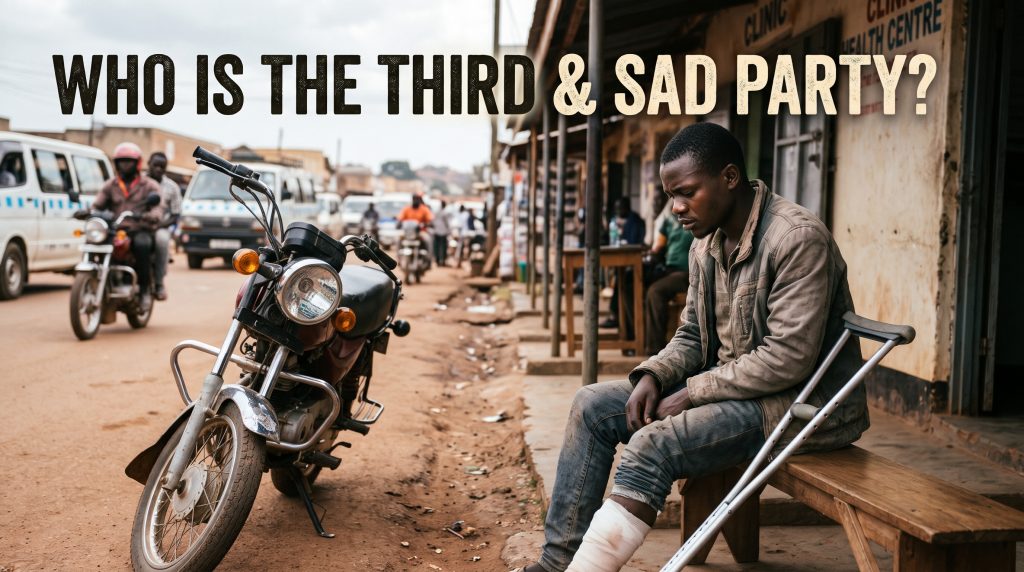
"When Okello’s boda boda was hit by a speeding car, he didn’t know what to do. The driver had third-party insurance. Okello was the third party. But he didn’t know that. He didn’t know he had a right to claim. He didn’t know the sticker on the windscreen, the one he’d never thought about, was actually for him. By the time he found out, the driver had disappeared, the insurance company said the claim was too late, and Okello was left with hospital bills he could not pay."
If you get into an accident, you must first establish who is responsible (the first party) and who the victims are (the third party, like Okello). The first party is responsible for their own medical expenses, as well as other liabilities under law. We shall therefore call them the ‘sad party’.
The victims of the sad party then have the right to approach the insurer to claim third-party coverage. If the third party does not cover the full cost of the damage, the third party has the right to pursue the sad party for additional money to deal with their damages.